Saturday, 15 April 2017

Security Situation in Afghanistan

SECURITY SCENARIO IN AFGHANISTAN AND PROSPECTS FOR COLLABORATION
By Lt General Chandra Shekhar (Retd), Indian Army

INTRODUCTION
  1. In Oct 2001, the USA, declared war on Taliban and Al Qaeda and ordered military action in Afghanistan. The Taliban were overthrown, but the movement, the clandestine warfare driven by the religious ideology and terror supported by Islamic leadership of few neighbouring states continues till today. We need to review the present situation, as the US led international security forces have wound down their combat participation, leaving behind only the military assets, and a minimum combat presence of 9800 personnel, which would also pullout in the near future. A minimum of 1000 of combatants are likely to be retained , as part of the Resolute Support Mission. The operational responsibility has been handed over to the Afghan National Security Forces (ANSF), who have not proved their operational effectiveness so far. Although, some improvement has taken place in the security situation through the sustained operations of the US-NATO forces, the Taliban and the Haqqani Net work have not been defeated effectively. The attack on the Afghan Parliament at Kabul on the 22 June 2015, clearly demonstrates the reach of the Taliban and the Haqqani network. The Taliban are still a powerful force in the South and have extended their reach further northwards, as also in the Helmond province, besides the thrust towards Ghor and Herat. The recent Taliban offensive in the Northern provinces of Kunduz, Badakhshan, and Faryab have already resulted in the capture of few districts. The writ of the government is also thin in the rural hinterland and the ongoing unrest is a cause of concern not only for the internal stability and the economic development of Afghanistan, but also for the stability of the entire Cenrtral Asian region due to the danger of spill-over to the bordering countries.

  1. The fighting presently has been bloodiest since 2001; civilian casualties have shot up by 38% to 8700, including 3400 killed by the Taliban and the ANSF has had large casualties (20,000) besides sizeable defections of the militia. Politically, there has been a democratic transition of power from President Hamid Karzai to the new President, Mohammed Ashraf Ghani, by the bformation of a National Unity Government (NUG) with Mr Abdulla Abdulla as the CEO. However, there are structural flaws in the power sharing arrangement and governance. The inability to conduct the scheduled parliamentary elections in April 2015 and to appoint the Governors in most of the Provinces, has put the state institutions into jeopardy. President Ghani has been able to conclude the Bilateral Security Pact with the USA and has been more pro-active in the peace process by seeking the involvement of the USA, China, and Pakistan to negotiate with the Taliban, both at the official and the informal levels. The talks held at Qatar and Doha have not been successful, due to the hard stand of the Taliban, who insist on total withdrawal of the US military and dismantling of base facilities in Afghanistan. They have even demanded a Sharia based new constitution and become more assertive. The Taliban are also using the media to propagate their radical ideology and even engineering defections in the government cadres. Attempts by other influential neighbouring nations such as,Russia, Iran , Pakistan and China to break the dead-lock have, so far, achieved little, although the recent talks, held with the efforts of China and Pakistan do provide hope for the future.


SECURITY AND GEO-STRATEGIC SCENARIO


3. The US withdrawal, from Afghanistan is not total and it retains some strike forces. It also has the required air cover, logistics assets and bases, besides training and advisor staff presence. A total force level of 9800, supporting the Afghan troops (ANSF) till 2017, to perform the security role and the US fleet of Drones, is expected to prevent the Taliban and the Haqqani Network from regrouping. To achieve this the USA will need a continued capability even beyond 2017 and the ANSF will need considerable assistance in additional equipment, training and the logistics support . The command and control of the Taliban and the Al-Qaeda based in Pakistan has been badly disrupted, but not eliminated. The US led intervention in Afghanistani, unlike the earlier interventions of the UK, and the Soviets has not been against the Afghan society and the tribal social framework, but against the fundamentalist elements of the Taliban, notwithstanding occassional collateral damages. The Afghan people have supported the US intervention to a large extent and welcomed the stability, economic development and restoration of the basic facilities. Restoration of their elected government has given them the pride and confidence in their nation, however, they need to be given support and help by other major powers and important donor countries. Perhaps a consortium of the donor countries coordinated under a UN Mission is the answer for better synergy.

4. Afghanistan, with its vast mountainous terrain has fertile valleys in most of its 34 provinces. The country abounds in dry fruits, grapes, wheat and minerals, but has poor connectivity and infrastructure. The sectarian strife, extremism, fundamentalism, narco-trade, along with tribal affinities spilling across the borders and the presence of foreign fighters in Afghanistan, have made the security environment fluid and unstable. However, there are new expectations in the country, and ordinary Afghans aspire today to live in peace, harmony and in a politically stable and secure society; make economic progress; reap benefits from their mineral and energy resources, and not slip back into conditions that prevailed during the war and the Taliban regime. They seek and look up to international aid from the friendly countries to invest in Afghanistan and participate in trade, economic reconstruction and development. They want their hard earned politico, social and economic gains to continue. They generally appreciate the US-NATO operations being conducted against the fundamentalist forces in their country and the economic assistance from the various donor countries.


5. Afghanistan borders Iran, Turkmenistan, Uzbekistan, Tajikstan, China and Pakistan and is a gateway to Central Asia. The dominant tribe of “Pashtoons'' are spread on either side of the “Durrand line” into Pakistan, whereas the other major tribes of Hazaras, Tajiks and the Uzbekis are in the North Eastern province. The tribal loyalties, though strong, are subject to the dominating tribe at a given time. Any change in the tribal domination does impact the leadership change in Afghanistan. The developments in Pakistan, Iran and the Central Asian Republic States (CARS) have a bearing on the security and stability of Afghanistan. Similarly, the role of major powers i.e., USA, Russia, China, and the important countries in the region i.e., Saudi Arabia, Turkey and India, besides the major 'donor' countries, i.e., Japan, EU, Australia and New Zealand need to be factored in. A review of the developing ssituation in Afghanistan and future prospects of collaboration is outlined below.

PROSPECTS FOR COLLABORATION


.
6. USA. The USA, undoubtedly, remains the most important player in Afghanistan. Its cooperation is essential for the stability and successful transition of Afghanistan into a well-knit nation, as also for the conflict resolution of the ongoing insurgency in the Af-Pak region. During the last decade, the USA along with its NATO allies, has primarily focussed on military operations against the Taliban and the Al-Qaeda, to bring about normalcy in Afghanistan. This has met with partial success. However, the equally important aspect of regional engagement for a lasting solution, with India, Russia, China and Iran, for cooperation and dialogue has been somewhat relegated. The USA, despite strong evidence of Pakistan’s duplicity, of giving sanctuary and support to the Afghan Taliban and sheltering Osama-bin-Laden and the other leadership of Al-Qaeda in Pakistan, has been soft in condemning Pakistan. This was primarily because Pakistan acts as a conduit for the logistics support for operations into Afghanistan. The USA, however, has been carrying out drone attacks on terrorist targets in Pakistan, based on hard intelligence. The exclusive US focus on military operations,ii resulted in inadequate attention to the economic development and reconciliation.

8. . Taliban continues to remain a potent force and would need to be defeated, before any total withdrawal of the US-led international force is contemplated—if we were not to repeat the mistake the Soviets made in their pullout in 1989. The US military strength and assets remaining in Afghanistan after the draw-down, must have sufficient deterrence capability to remain effective and credible, which does not appear to be so at the moment. The presence of the US forces, though opposed by the Taliban and the other Jehadi forces, is sought by the Afghan Government, and in fact, is welcomed by most of the countries in the region. Even the USA, despite its domestic compulsions, has geo-strategic interests in retaining the bases for possible future options in the Central Asia or Ukraine. The recent resurgence in the insurgency operations by the Islamic State of Iraq and Syria (ISIS) in West Asia is forcing a rethink on the US strategy in the region, and would warrant a review and enhancement of the US combat mission in Afghanistan.

9. The USA realises that the Taliban forces have varying degree of domination in twenty out of the thirty-four Afghan Provinces and it cannot impose a peace deal on its terms. The US administration has, therefore, decided to open talks with the Afghan Taliban, and has sought cooperation from China, Saudi Arabia and Turkey, who have considerable influence with Pakistan. The USA, despite its significant leverage with Pakistan—having provided her 27 billion dollars in civil and military aid over the last decade as compensation for the logistics and base facilities for operations in Afghanistan—has not succeeded in her efforts to dismantle the Haqqani Network and eliminate Pakistan's support and encouragement to the Taliban. The annual US Report released on terrorism for 2014, once again called out Pakistan's two-timing on terrorism, detailing the country's patronage of some Afghan terror groups including the LeT, who freely operate in Pakistan. Operations against the Taliban undertaken by Pakistan are only limited to the Waziristan province, that too reluctantly. It is well known that LeT operates against India in the J&K, while the Al-Qaeda and the Haqqani Network concentrate on Afghanistan; yet the USA is soft on Pakistan.

10. Although, the Bilateral Security Pact (BSA) has recently been concluded, by the USA with the new Afghan regime, the Afghan National Security Forces (ANSF) are not fully equipped to take over the military operations, and would need more time to train appropriately. A new strategy needs to be formulated by the USiii military-training teams to train and advise the ANSF field units, just as such a practice is being revived in Iraq for operations against ISIS. Countries like India and Russia, who have had long association with the ANSF, should be gainfully incorporated in such an effort, with the US being in the lead. Finally, peace efforts in Afghanistan should be made more comprehensive by associating countries like Russia, India, Iran, China and Pakistan. In the ultimate analysis, it is winning the ‘hearts and minds' that would become the game changer. Greater efforts need to be made by the USA and its allies for more economic assistance programmes as part of a UN mission, or by larger coordinated participation by donor countries.

11. Russia and the CARS. There are indications of active Russian involvement in the Afghan peace process with talks with the Taliban, the Russians would also like a peaceful and moderate regime in Afghanistan post-US withdrawal. The CARS are moderate Islamic states with past linkages with the Russians and fear the radical ideology of the ISISand Taliban. They have considerable energy and mineral resources which they aspire to develop for their economic progress by retaining friendly relations with Russia and China.iv Russia and the countries of the Central Asia will be wary of a radical regime in Afghanistan that would harm the interests in the CARS, or support the Islamist terrorists in the CARS and in the Russian federations like in Chechnyan province. The Russians have been making the largest contribution to the security of Tajikistan, where they have stationed a rifle Division and accept the continued US presence in Afghanistan—till the Taliban forces are fully defeated—but they would want the US to dismantle bases from Afghanistan and the CARS. Russia is likely to provide assistance to the CSTO and possibly SCO to fight the ISIS/ Taliban influence in the CARS. Russia has had earlier association with the Afghan military and could provide military training and equipment to Afghanistan. The SCO can play an important role in Afghanistan post US withdrawal.


12. China. China has been pragmatic in pursuing its policies with Afghanistan and securing its national interests. It has signed the Strategic Partnership Agreement with Afghanistan in 2012 and undertaken economic engagement in the mining and energy sectors. It also shares a border in Xinjiang province and thus, has security interests in the region. It has very cordial relations with Pakistan and is apparently tolerant of Pakistan's support to the Taliban as a strategic compulsion beyond her control, and because of its special relations with her. It shares common goals with the USA and Russia of maintaining stability and economic reconstruction in Afghanistan. The tri-lateral dialogue between China-Afghanistan-Pakistan has tremendous potential for brokering peace with the Taliban. It is learnt that the Taliban have welcomed China's involvement and have sent a delegation to China immediately after President Ghani's recent China (Oct 2014), visit to discuss Afghan related issues. The talks were attended by the Afghan Government Officials , the Taliban and the officials of Pakistan's ISI. However there are elements both in the Afghan Government and the Taliban leadership who are opposed to the talks.

13. China with her economic resources, military potential, diplomatic influence, special relations with Pakistan and a shared border with Afghanistan has significant potential influence and can emerge as a decisive player. However, it needs to shoulder greater responsibility by more active participation in defeating the Taliban, both by military means and political influence. Will it also cooperate with the USA, Iran and India in the economic development of Afghanistan in an integrated effort, is a relevant question? There are other important donor countries, including Japan and India, involved in the economic reconstruction, who need protection and security for their investments and personnel. Will the Chinese assist in ensuring security against the Taliban by joint operations or a UN supported mission? These are pertinent issues to be addressed. A dialogue between China-Afghanistan-USA in the future has tremendous scope to get the Taliban to negotiate a peace deal.

14. Pakistan. Pakistan is the most important neighbour, with a common border, similar cultural and religious affinities, controls access to the sea ports to the land locked Afghanistan. Pakistan considers Afghanistan as her strategic backyard and is part of the Afghan problem by giving sanctuary to the Afghan terrorists on her territory. There are many challenges to Pakistan’s engagement with Afghanistan, especially in how it confronts the Taliban sanctury on its soil and how it deals with the Taliban, LET and the Haqqani Net work. The biggest challenge to Pakistan is the internal insurgency in Waziristan and FATA. This situation has come about by Pakistan indiscriminately arming and supporting the Taliban cadres and the Afghan refugees for terror attacks in Afghanistan. These elements have become heavily indoctrinated, and a restive powerful force. Pakistan Army has belatedly undertaken counter-insurgency operations in her own territory to subdue these forces.

15. Pakistan has also deftly played its cards, both, as an ally of the US operating against the extremists and extracting financial compensation from the US in return, as also clandestinely supporting the Taliban, to secure its future long term prospects of an amenable government in Afghanistan. It sees India's growing presence in Afghanistan and its friendly relations with the Afghans adversely—as an attempt by India to surround it from the rear. There is strong evidence that Pakistan has been actively sponsoring Taliban attacks on Indian aided projects and on Indian facilities. Afghanistan, despite her protests to the Pakistan authorities has found no response, except denials from them.

16. Pakistan does not allow connectivity between India and Afghanistan through its territory. It wants to limit India's influence and make Afghanistan entirely dependent on her, rather than realize the direct economic gains that would accrue to her by trade and transit facilities, being a natural land bridge. A large population of Afghanistan views Pakistan as an impediment to Afghanistan's economic progress since it provides support and sanctury to the Afghan Taliban involved in violence and terror attacks in their country.


17. Recent overtures of President Ashraf Ghani to facilitate, reconciliation and mutual cooperation with Pakistan including joint military operations against the terrorists, with a nudge from the USA, have not resulted in meaningful military cooperation. The recent Pakistani facilitation of the peace talks with the Afghan Taliban at Murree is a good step and need to be followed up.China with her very cordial relations and influence with Pakistan can help to bring about a change in the attitudes and mindset of Pakistan. China can prevail over Pakistan to bring about moderation in the security environment in the region. Pakistan herself is attempting to quell the internal insurgency, as they are causing terror attacks inside Pakistan. Pakistan is also attempting to normalise relations with Afghanistan and re-energise its policy towards the CARS for trade and energy. However, Pakistan is also using the US withdrawal of the combat troops and its fallout, to penetrate Afghan institutions and regain its influence to obtain its aspirations of strategic depth in Afghanistan. A large section of the Afghan population, do not trust the Pakistani leadership, as the Afghan Taliban and the Haqqani Network continue to retain safe havens in the Pakistani territory and launch terror attacks in Afghanistan, including the recent attack on the Parliament Building at Kabul on the 22 Jun2015.

18. Iran. Iran is the other important neighbour of Afghanistan and an alternative trade and transit hub. It shares a long border and has cultural, religious, and linguistic affinity. It provides pragmatic support and stands for a multi-ethnic Afghanistan. Like Pakistan, it has more than million Afghan refugees to be repatriated, besides a long standing bilateral dispute (pertaining to the Helmund River) to settle. The Iranian government has been engaging with the international community to bring about a political solution to the long drawn conflict in Afghanistan. Iran has friendly relations with India, Pakistan and China, which if harnessed jointly with the USA, can bring about a substantial transformation in the situation in Afghanistan.

19. It has made significant investments in development of Afghanistan, in areas of Herat and along the western border. It also provides an alternative trade and transit route to Afghanistan, through its road, rail system and access to Sea through its Chabahar port, which is being jointly developed with Indian assistance. The Afghanistan-Iran Strategic Cooperation Agreement of August 2013 is a comprehensive instrument for military cooperation, intelligence sharing and counter terrorism. Iran,with its strategic location, traditional goodwill, economic and cultural linkages with Afghanistan, can help broker a peace agreement in Afghanistan. It should also take greater responsibility for the security of the western Afghanistan and the border areas it shares, against the Taliban attacks, as part of the Strategic Cooperation Agreement with Afghanistan.


The Indian Perspective

20. India has historical, geo-political and strategic interests in Afghanistan and the CARS. The region forms part of its strategic neighbourhood. The rise of terrorism in the region egged on by Pakistan was almost exclusively targeted at India in the initial few years. In the period between 1989-2002, Taliban-controlled Afghanistan launched many Jehadi attacks in India at the behest of their Pakistani masters. The possibility of such a scenario recurring post US withdrawal, will not be in the Indian interest, or in the interest of Afghanistan and the region as a whole. This should not be allowed to happen, for the regional stability and the unhindered development of Afghanistan. As things stand today, the situation in Afghanistan is getting worse and the Islamic Jehadis and the Taliban are steadily increasing their influence. India needs not only to voice its concern, but also to evolve its own strategy to deal with the Afghan fallout, both to protect its investments and personnel deployed in Afghanistan, as well as to prevent escalation of the hostile activities of the LeT in the J&K.v

21. Indian focus in Afghanistan has been on continuing to provide the wherewithal to assist them in their reconstruction and to support the Afghan people in their efforts for a peaceful and stable Afghanistan. Four land mark projects that have been completed in the infra structure development include the Delaram–Zeranj Highway connecting Kabul, Kandhar, Herat and Mazar-e-Sharif to the Iranian port city of Chabahar. The transmission lines have been built by India, to transmit the Ujbek electricity to Afghanistan, besides, the new hydro electric Salma Dam, and the Parliament building in Kabul. India today is the 4th largest donor towards rebuilding of Afghanistan. India is also building hospitals and Steel and Power plants, besides providing them teachers and training the Afghan Security Forces in the Indian institutions.

22. India, firmly believes, that the reconstruction and the economic development should be Afghan led and Afghan owned. Perhaps, for effective coordination and development of infrastructure, there may be a need for a UN mission in Afghanistan. It is further felt that the ANSF be assisted in training, equipment, and operational planning by the USA, and by other important friendly donor nations. The assets being created and the task forces of the countries involved in the reconstruction should be provided security, against the Taliban attacks jointly by the donor countries and the ANSF. There have been instances where the Indian missions and personnel engaged in reconstruction of the infrastructure projects have been targeted, by the radical elements operating from Pakistan. Such acts must not only be condemned, but suitable steps be taken to ensure security of the aid missions under UN cover. India should consider deploying its own security elements for the protection of its assets, if the other efforts do not succeed.

23. In 2011, India and Afghanistan signed a Strategic Partnership Agreement. India has given a Rs 2 billion economic assistance to Afghanistan and has set up medical missions at Kabul, Kandhar , Jalalabad, Herat And Mazar-e-Sharif, treating more than 400,000 Afghans annually. India has offered facilities for Afghan students at the Indian institutions, and sent experts in Communication Engineering, water treatment and for projects in education. The visit of the President Ashraf Ghani to India, in April 2015 has given a fresh opportunity to both the countries to further strengthen the bilateral partnership and to review their relations realistically, particularly, in view of Pakistan's persistent suspicions of India's contribution and role in Afghanistan.vi India being a traditional friend and a major contributor of economic assistance to Afghanistan, enjoys respect in Afghan society. India's security concerns and protection of its assets in Afghanistan have to be given due consideration by the International powers.


CONCLUSION


24. The re-emergence of the radical forces and extremists in Afghanistan is certainly not in the interest of Afghanistan for its stability and the economic growth. The economy is showing a downward growth; there is increase in unemployment, slowdown in investments and flight of capital outside the country. These insurgents have to be defeated by support from the major powers jointly, with the Afghan Forces. A moderate, stable, and secure Afghanistan is in the interest of the entire region. Islamic radical forces in the past have been targeting India in particular. India would recommend that an international security guarantee be given to Afghanistan, backed by the ''Afghanistan-USA Bilateral Security Pact'', European Union, Russia, China and Iran. China and Iran, in particular, being Afghanistan's neighbours, with a shared border and important regional players need to share the security responsibilities, with the US. The challenge for all, is how to prevent conflict and establish peace in a durable manner, so that socio-economic and human resource development can take place at the desired rate.

25. The economic development, building of the infrastructure, institutions and a democratic polity is a major effort, to be undertaken over a period of time. The two essential pre-requisites for this are to ensure a secure and stable environment free from the external forces, and the other equally important factor of Afghanistan's internal dynamics, by balancing the tribal rivalry and preventing further radicalisation of the Afghan society. The other major essential ingredients are the resource availability, creation of economic assets and the transportation corridors which can only happen with an international effort, coordinated under the UN mission. If this is not done, then the whole effort of ushering a ''decade of transformation'' would remain an elusive goal.

26. Afghanistan also provides an opportunity for regional cooperation between South Asia, Central Asia, China and Iran. In this regard, the Indian model of partnering Afghanistan in the socio- economic development, keeping in mind the best interests of Afghanistan needs to be examined for adoption by other countries. The Chinese initiative of the “New Silk Route'' for creating a transportation corridor and the gas pipe line for energy utilization are other important steps for the regional integration, although,India has concerns with the proposed economic corridor to Pakistan as it passes throug the POK region of the Indian province of J&K. The tripartite agreement between India-Afghanistan and Iran to develop the Iranian port of Chahbahar to facilitate transportation of goods from Afghanistan, as an alternative to Pakistani ports, is another viable initiative for regional integration.

27. As of now, the Afghan government's attempts at reconciliation with the Taliban is unlikely to succeed as the Taliban is attempting hard to strengthen its control over the high ways,and the key cities in the South and the North -Eastern provinces. The Taliban will continue to maintain pressure on Kabul though it is unlikely to come to power. The, USA, and the allies must continue to support the Afghan government, militarily as well as , strengthen the state institutions and assist in the economic reconstruction, along with other donor countries, other wise all the efforts of the past 14 years will go waste.


References.


i The Unfinished War in Afghanistan(2001-2015), Bishal Chandra, Pentagon Press , New Delhi,2015.

iiAfghanistan Beyond 2014, From ' Rhetoric to Reality', An Indian Perspective, Lt Gen PK Singh, USI Occasional Paper, 2014. New Delhi.

iii‘New Strategy Takes Shape’, Harsh V Pant, Deccan Herald, 13 June 2015, New Delhi.


ivAfghanistan Beyond 2014, From ' Rhetoric to Reality', An Indian Perspective, Lt Gen PK Singh, USI Occasional Paper, 2014. New Delhi.


vIndian Strategic Interest In Afghanistan, Wing Cmdr, A Gupta,USI Journal Vol CXL1, No 589 Sep 2012, New Delhi.


viAfghan Peace Talks Fail over Taliban Demands, Praveen Sami ,Indian Express, 06 June 2015 New Delhi.


Sunday, 11 September 2016

Gorkha Hat and Maroon Beret: Everyman an Emperor


Gorkha Hat And Maroon Beret is a personal memoir of four decades of life in the Indian Army, as experienced by Lieutenant General Chandra Shekhar, former Vice Chief of the Indian Army (1997-2000). It recounts the rewards and rigours of his long and distinguished military career, after he was commissioned in the 2/4 Gorkha Rifles of the Indian Army in 1959. The book additionally contains larger reflections on the ethos and training of the Indian Army, and its seminal role in shaping the lives of not just military personnel, but the entire nation.
It also records valuable insights and suggestions about the way in which the institutional framework of the Indian Army can be further strengthened, especially after the experience of the Kargil War, at which time Lieutenant General Chandra Shekhar was the Vice Chief of the Indian Army.
Written in an engaging style, and from the vantage point of his varied command and staff experiences in various defence formations all over the country, the book is published at a time when 200 years of the raising of the first battalion of the famed Gorkha Rifles have just gone by. It will be of lasting interest to military and laypeople alike.

Excerpt from a review of the book by Major General R Naidu:
“Gorkha Hat and Maroon Beret” was so riveting that I finished it in one sitting on a train journey. It is the story of an eventful life in the army. A sense of excellence is evident at every step - in school and college days; first time success in the entrance exam for the NDA; superlative gradings in all the formative courses; promotion to the highest rank as a natural result of excellence at each rank. There never was an occasion for a representation as is the wont even in senior ranks of late.
To add to it, ancestry – a soldier father with soldierly virtues which were so obviously implanted for integrity and industry; physical fitness and ability in sports as a result of the background of a hardy child of the mountains; the genes of a hill boy so suited to a life in the army and that too in the infantry.
Moving on to the land mark achievement of the command of the Para Brigade with great distinction; the jumps accomplished in such short order; and the transition from an operations and training-addicted leader to looking after the welfare and comforts of the troops as the Army Commander of Central Command, speaks highly of a human and humane side of the author.
 The Kargil Operations discussed in the book, throw up many issues for critical observation and reflection. Only our troops can react the way they did once we decided to take action to evict the intruders. All in all, a great book and of great value to the service readership.

Major General R Naidu 

For more reviews:

https://books.google.co.in/books?id=NjdIDQAAQBAJ&sitesec=reviews
http://forceindia.net/TheMakingofaGeneral.aspx


For further information and for placing orders:

Ambi Knowledge Resources Pvt. Ltd.
Lower Ground Floor, C-4/5
Safdarjang Development Area,
New Delhi - 110016
India
Email: ambi.knowledge@gmail.com
Phone: +91-11-49562700


Wednesday, 17 June 2015

COS of HQ Western Command; GOC of Chetak Corps and Sudarshan Chakra Corps.


As my turn came for promotion to Lieutenant General, I was informed by the COAS, General Rodrigues, during a visit to HQ 15 Corps that he had earmarked me to take over command of 15 Corps in July 1993. Since I had already done over two years as COS at the same location in a difficult period, I requested him for a change. My father was, at 93 years, not only of an advanced age, but had also been ailing for some time and needed care. I, therefore, told him that I would prefer to be posted to a place which had good medical facilities. The COAS accepted my request. He posted me as the COS HQ Western Command to succeed Lt. General B.K.N. Chibber, PVSM, AVSM, who was being moved as the Security Adviser to the Government of Punjab. This was to be an interim posting till a vacancy for the corps commander occurred. Accordingly, I got a short tenure of six months as the COS with the then Western Army Commander, Lt General GK Gulati, PVSM. This enabled me to get familiar with the operational tasks of Western Command, as also with the ongoing operations of counter-insurgency in Punjab, which were in the final phase of consolidation.

The dynamic Chief Minister, Shri Beant Singh, along with the very competent DGP, Shri KPS Gill, were well in control in Punjab. There was unity of purpose and very close coordination between the civil administration, the Police and the Army in the conduct of the operations. In Punjab, by and large, the civil society was not with the insurgents, which enabled a quicker return to normalcy. The media also played a positive role by providing a very balanced coverage of the events. The actual task of eliminating militancy was undertaken by the Punjab Police, while the Army provided them with a secure environment by dominating the rural areas and the border belt during night time. At the Command level, in addition to the planning for the conduct of the counter-insurgency operations, there were operational discussions, tactical manoeuvres, and war games. As the COS, I found that there were many administrative installations, hospitals, and logistic units which needed attention. Their supervision and reporting were under the direct responsibility of the COS, and I was able to visit these various installations as also familiarise myself with the entire western border in Punjab, during my time there.

 In November 1993, I was appointed GOC of a pivot Corps, while it was undergoing the yearly operational alert. This was one of the most important pivot corps of the Indian Army providing a pad for launching operations, with considerable resources on its orbit. Its armoured content was as much as that of an armoured division. The Corps also had an independent Artillery Brigade with the 155 mm (Bofors) guns. The Corps Key Location Plan (KLP), at Bhatinda, Suratgarh, Bikaner and SriGanganagar was still under development at that time. Major General J.S. Dhillon, my COS, was of great help in finalising the KLP and other infrastructure. Maj General Vinod Sehgal was GOC of one of the divisions; Maj General N.C. Vij (later COAS) was in command of the other; and Maj General C.S. Panag was the GOC of the third Infantry Division. The Corps was also a test-bed for developing the “Battlefield Surveillance Centre” and the “Artillery Command and Control Centre”, which have now been made operational in the Indian Army. Aspects like offensives across deserts and riverine terrains and reduction of strong points were perfected.

During our stay at Bhatinda, our daughter, Anisha got married. The wedding was solemnised at DSOI, New Delhi. I deliberately held the wedding outside my corps zone, to ensure that my subordinate commanders and staff did not flock to the wedding with gifts. I also disallowed leave to the officers to participate in the event. Some of my officers may have thought me too strict. But my purpose in organising the wedding function of my daughter outside my Corps area was quite clear—private functions must remain private in the Armed Forces. And I mention it here, to highlight the tendency at times to use official facilities for private purposes in many departments. This leads to misuse of resources and promotes corruption, and senior officers must set an example to discourage such a trend; we emphatically must not follow the precedent of our political leadership and other government officials in this regard.

Most of the stations in the Corps, i.e Bhatinda, Suratgarh, Bikaner, SriGanganagar, Lal Garh Jattan, and Kota, were small or new towns. The cantonments there were not fully developed. The Army, today, by its efforts has developed good sports facilities, opened new schools, and constructed housing complexes and hospitals in most of these stations. All this systematic work has also helped in restoring the confidence of the civil populace, in ensuring better governance, and in normalising the situation on the ground from anti-national elements. It is often not fully realised that the Army, in this process, plays a significant role in the development of infrastructure of remote areas, smaller towns and the border belt. The civilian population and the retired veterans also feel involved in the task of nation building.
The army units in peace-stations basically are either involved in training for war, or are there for much needed rest and refit from the pressures of the field areas. The Infantry units have their peculiar needs for reorientation to the new environments, as unlike the specialised units, the Infantry units mostly come from a hard field-station to the peace-station on rotation. They need time to get their families and the shortages and low scaling of married accommodation (approximately 15%) permits tenures of less than a year. Formation Commanders need to cater for their special needs and must not give them additional duties, other than their operational tasks, which often appears to be the norm. The training commitments of the units located in the peace stations, particularly specialist units such as Air Defence Regiments, Assault Engineering Regiments, Armoured Units and Artillery Regiments need coordination as the firing ranges are few and far away.

I was able to conduct the planned two weeks operational familiarisation of all the formations, preceded by a Corps Level War Game at the operational locations in November 1994. This also enabled me to meet a large number of my units and their officers on the ground. Thereafter, Infantry Div (Rapid) under Maj Gen Vinod Sehgal was exercised on the offensive operations astride the canal/river obstacle along with the independent Armoured Brigade. One Infantry Brigade of the other Infantry Division provided the “enemy force”, and the third Infantry Div was tasked to provide the control and umpire organisation. The exercise was supported by the other supporting arms and services fully. Such exercises enable the units to practice battle-craft and drills. The Army Commander, Lt. General G.K. Gulati, PVSM, witnessed the exercise and gave some valuable advice. The GOC Div, Maj Gen Vinod Sehgal, was a fine soldier and an imaginative Commander, and tried out some new concepts although most commanders these days do not try out anything new, for fear of making mistakes and adopt the well-beaten and predictable paths. In fact, new concepts and ideas are often run down.

As I was just about settling down as the GOC, I was pleasantly surprised to get my transfer orders as the GOC of a strike Corps, located at Bhopal. The command of one of the strike Corps of the Indian Army is an honour, which any professional soldier would aspire to. I took over the command of this Corps from Lt General K.M. Seith, AVSM, a fellow paratrooper and a friend. The Corps had its armoured elements located in Central India, with other two formations at Ranchi and Secunderabad. The Corps was well spread with units at stations like Trivandrum in the South to Barrackpore in the East, Pune in the West and Delhi in the North.  Some of the supporting formations were still under the process of being raised. The Corps HQ was housed at Sultania Infantry lines in some makeshift accommodation, with some units in tentage and TRS (Tent Replacement Scheme) huts in the EME Centre Complex at Bairagarh.

We raised the Air Defence Brigade at Dehu Road and moved the Independent Arty Brigade to Aurangabad. Both these stations proved to be good assets to the Corps, as these also had good education facilities. I was able to visit various formations and assess their training needs. The Division, ex Ranchi, was practised in move and deployment in the Rajasthan deserts for training. The long time taken for this induction and deployment was a matter of concern and was suitably rectified later by the Army HQ, by allocating another formation from Central India. This improved the operational capabilities of the Corps further. We were able to conduct a full scale exercise in the deserts, codenamed Chakravyuh, by all the formations, including the Armoured Division, with the training tanks, the Artillery and the Engineering brigades in full. HQ Southern Command provided the ‘enemy’ troops. I was also able to get the Air Effort, including helicopter lift, for a Special Forces battalion lift for the exercise. The exercise was witnessed by the COAS and the Air Chief. Maj General Vijay Kapoor was able to exercise the Armoured Division in a realistic setting in the deserts and along with the other Divisional commanders practice various concepts of offensive missions. The logistics Services were also able to get fully exercised.

It took considerable time for the formations and units to de-induct to their respective permanent 
locations, spread in the South and Central India. This also gave us the opportunity to see the variety and diversity and uniqueness of India’s heritage during our visits to the formations. My wife accompanied me during some of my visits to these stations and acquainted herself with the education and the associated issues of the family welfare. The infantry units, I noticed, were always pressed for time doing numerous tasks, since they get to the peace station tenures for a short 2-3 years, before going back to the field. The commitment on station duties, assistance to civil authorities during natural calamities, time for operational training, therefore, needs to be balanced realistically.

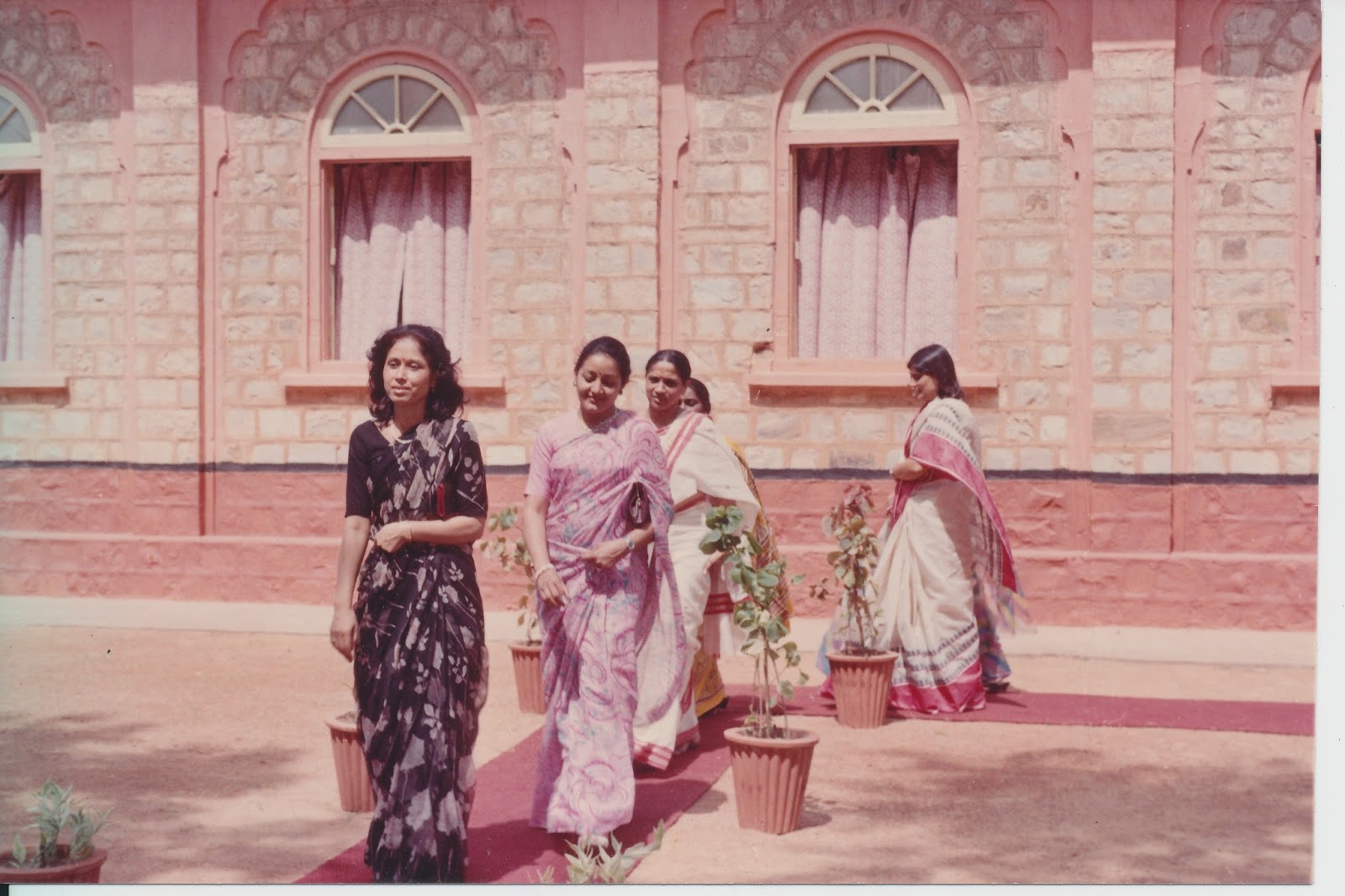
Aruna with the ladies of the Station


Receiving the COAS, General Shankar Roy Chowdhary
The Corps has the Sudarshan Chakra as the emblem, depicting the ultimate weapon of the Gods, and true to its emblem, over the years the equipment profile and high professional standards have made it the real ‘cutting edge’ of the Indian Army. Having visited the Corps HQ at Bhopal for a reunion recently, and having seen its professionalism, the new accommodation and the sports facilities, made one feel proud of belonging to such an elite formation. The enhanced financial powers of the formations today, along with the new concept of HQ Sub Area being placed under the command of the Corps HQ have enabled better integration and response for logistic installations as compared to earlier times.  The quality of maintenance of the buildings, the roads and the completion of urgent works improved consequent to the new arrangement of the Sub-Area HQ being placed under the Corps HQ. The Army, today continues to retain its traditional standards of excellence, competence and high professional standards. A visit to any of the Army stations is always refreshing and rejuvenating and the senior officers’ conclaves and the periodic reunions contribute greatly to further enhance the standards.


Monday, 4 May 2015

AN AMICABLE SOLUTION TO THE J&K ISSUE


 The dispute between India and Pakistan over Kashmir stretches back to 1948 and the problem has been further complicated by the Pakistan sponsored insurgency after 1989 -90. The dispute is not only a territorial and a political problem, but also an emotive issue deeply affected by the internal dynamics of India, Pakistan and the people of the J&K state. Any solution to the protracted problem must satisfy the differing perceptions and aspirations of all the parties involved.

The rigid stands adopted by the three stake-holders to the conflict prevent accommodation and any settlement, unless all the competing parties are willing to be more flexible and accept some level of compromise to their stated claims. Any viable approach in tackling the issues must not only respect the sovereignty and the territorial integrity concerns of India and Pakistan, but also the popular aspirations of the people of J&K. The key to resolve the issue lies with the governments of India and Pakistan, as the people of J&K and POK (Pakistan Occupied Kashmir) see themselves as either victims or hostage to the policies of one or both the States. The complex character of the dispute cannot be solved without the active cooperation of the two States and Pakistan has to refrain from supporting the various terror outfits operating at their behest in the J&K, and assist in enabling an environment conducive for meaningful talks.

It also needs to be understood that the aspirations of the different regions of J&K are not similar. The people of Jammu and Ladakh, and the Gujjars and the Paharis of the hills do not support the separatists, excepting the more vocal Sunni population of the Kashmir valley. The Sunni population of the valley have identified more closely to the separatist cause and their proxies in Pakistan. In fact, these five districts in the valley, out of the total 24 districts in the entire state, have a population of only 30% but have been given disproportionate amount of importance and representation - both in the state legislative assembly and at various forums. It needs to be realised that they, through the “United Jehadi Council” or the “Hurriyat” do not represent the aspirations of the entire state. We thus, need to involve adequate representation of the people from the other regions of the state in any future talks, as a composite delegation that represent all sections and elected members, rather than just the Hurriyat, who focus on the concerns of only the separatists and the alienated people of the valley. 

Unfortunately the various think tanks and the official agencies of the Central Government in the past have also neglected the demands of the other regions, so much so that the refugees of 1947 who had migrated from Pakistan to Jammu still continue to be stateless, and without any rights of citizens. On the contrary, the migrants from Tibet after the Chinese ingress of 1950, have been given the status of state subjects. The resettlement of the Kashmiri Pandits in the valley remains unresolved as they fear for safety and feel unwelcome. This is certainly not an example of fair-play that ensures equal treatment to all the regions and communities. The issue of the Northern Areas, Gilgit and Baltistan and their unauthorised annexation by Pakistan is hardly ever discussed by India or the so called Hurriyat who claim to represent and voice the concerns of the people of J&K. Thus, the Kashmir issue is driven by a complex network of multiple interlocking dimensions, which requires a skilful compromise of the conflicting demands. To resolve this complicated dispute we need to identify and address the entire range of issues that have relevance to the possible solution of the J&K issue. These are discussed in the succeeding paragraphs.

Issues Relevant to the Possible solution of the J&K issue
2. The external dimension of the Kashmir issue concerns the territorial status, the geographical borders and the applicability and the relevance of  the outdated UN Security Council Resolution of 1948, which have been overtaken by subsequent events, and the successive democratic elections in the Indian part of the J&K during the last six decades in the state. Pakistan continues to raise the outdated issues, despite the fact that she has not pulled back the troops from the POK, which was the prerequisite for the promised plebiscite. Implications of the illegal ceding of the Shagksham valley to China by Pakistan also needs to be factored in while considering the external dimension, as also the unauthorised integration of the Northern Areas and Baltistan by Pakistan. The internal dimension examining the aspirations of the people of the J&K must include all the regions including those of Jammu and Ladakh. In fact, the Muslim population of the Jammu and Ladakh also endorse the case for accession of the state with India. Even the Shia community in the valley, which is about 12% does not support the separatists cause. However, the demand for good governance, greater autonomy, economic development and greater trade, commerce and cultural exchange across the LOC/ borders is widely accepted, by all the regions, except the Hurriyat, who as the proxy of Pakistan plays the negative role of strikes, encourages non-cooperation and incites violence . The Hurriyat feels at-home talking to their Pakistani masters and avoids talks with the Indian Government. This clearly reflects their affiliations, preferences and priorities, yet they clamour to represent the voice of the J&K?

It is true that the Central and the state governments in the past have made serious mistakes by rigged elections, central meddling in the state, corruption, denial of legitimate demands, use of force and large scale arrests, which resulted in unprecedented anger and alienation in the valley. This alienation was exploited by Pakistan by infiltrating jehadi cadres, arms and ammunition in the Kashmir valley. This has been corrected to a large extent by the firm action against the insurgents by the armed forces, civic action programmes and the economic development activities by the central and state governments. The action by the armed forces has been generally fair and supportive, with the use of minimum force, barring few aberrations. The armed forces have had to operate in difficult situations, where a hostile vernacular media and foreign sponsored propoganda and the foreign funded Human Rights organizations have attempted to malign the armed forces. Although the majority of the civil population is no longer misguided and prefer to lead a peaceful life, the hardcore militants persist in their sinister designs, actively supported by Pakistan.

Such a situation would continue as long as Pakistan with her anti-India agenda and her proxies in the state will not reconcile. This is a factor which is unlikely to change while we address the internal dynamics of the J&K. The main participants in the future dialogue process thus, should be the elected representatives of the people from the three regions. The Hurriyat should be invited as one of the players representing the seperatists, but should not be given undue importance in the parleys - even if they decline to participate, which they are most likely to do unless Pakistan directs to them to do otherwise. The present thrust on the economic development in the state, greater devolution of powers and mainstreaming with the rest of the country should continue, enabling a conducive atmosphere for the redressal of grievances. Conflict resolution would take considerable time and requires persistent effort by all the agencies and the stake holders.

Alternatives and options
3. Given the above background , what are the various alternatives and options to resolve the complex internal and the external dimensions of the Kashmir issue? Some analysts have  suggested that we should adopt the model of the Northern Ireland  between the Republic of Ireland and UK , the so called “Good Friday Agreement '' for settlement in the J&K. A dispassionate examination would reveal that there are differing conditions and environment between the two. In the Northern Ireland there were similar cultural, linguistic and economic conditions as those prevailing in the Republic of Ireland, with a more homogeneous society. The ground realities of diverse religious, multi-linguistic, multi-ethnic and differing social conditions in the J&K have to be considered, besides the deployment of the two armies on the live borders. However, a few aspects from the Irish model could be adopted with suitable modifications. Recognising and respecting the two identities of the two sovereign states of India and Pakistan in the respective territories along with the Kashmiri identity will have to be accepted by all, as the starting point.

Secondly, the peace process in Northern Ireland was driven by the determination of the British and the Irish states. Such an environment in our context is presently lacking and the cooperation of Pakistan would remain suspect and a question mark. Thirdly, Britsh-Irish inter -governmental cooperation was greatly facilitated by the European Union (EU), as both the states were members of the EU and accepted by the two as the forum to discuss the issues. Such a regional grouping is not available between India and Pakistan as the SAARC has not matured to take on such disputes. In the Irish model, the USA also acted as a facilitator and mediator, but the role of the third party as a mediator is not acceptable to India. The Shimla Agreement and the Lahore Declaration(1999) do provide a broad framework for the two countries for talks provided there is evidence of political will in Pakistan. At times, there is often a demand in India to abolish article 370, particularly by some hardliners. Article 370 provides special status to Kashmir within the Indian union to maintain its exclusive identity as part of the accession instrument. Abrogation of this article would be a retrograde step. This article provides the legal basis for accession with India and should clearly be retained, as any tampering with this article will only harden the public opinion in the valley.

There is another controversial issue raised by political parties in the J&K, of repealing AFSPA from the state. This act enables the armed forces to operate in the conduct of anti-insurgency operations legally. Repealing of this article should only be done gradually from the districts where the situation has been normalised, based on the recommendations of the state. The Army and the PMF should also be withdrawn from the towns to the selected locations outside the urban centres, leaving the state police to handle law and order functions. The long term goal should be to strengthen the capacity and the calibre of the J&K police to undertake all the security tasks in the state. The Army's presence along the LOC and its anti- infiltration grid in the depth will have to be retained and cannot be diluted in the near terms, till the final settlement of the Kashmir dispute between India and Pakistan. Any talk of demilitarisation is also premature, till Pakistan dismantles its terror infrastructure and reduces its own forces from the LOC and POK.

4. An important lesson from the Irish model which could be adopted is the creation of an 'inter-ministerial joint council' between India and Pakistan, which would resolve all the inter-state disputes and take further steps to enhance mutual relations in trade, tourism, irrigation and power, education, sports  and cultural exchanges. This Joint council would have to operate directly under the two Prime Ministers to be meaningful. The most important step that needs to be taken is to accept the LOC as the geographic border between the two countries with suitable modifications to make it more realistic on the ground. This is the most difficult decision and the most important one failing which no normalisation would ever be possible except the status-quo situation as on today. This decision to convert the LOC as the border would lead ultimately to making it as the soft border and open up tremendous opportunities to both the sides and to the Kashmiri people; however forces in Pakistan, the Army as well as the Jehadis and their proxies in the J&K would resist and not let this happen. In such a scenario - which is most likely - resolving the Kashmir dispute and enhancing inter-state linkages, appears extremely difficult. At the same time it should be clear to all that any hopes of redrawing the borders by military actions or the aspirations of separatists for “Azadi” will not be realised or allowed to be fructified by India. The sooner this truth is realised across the borders and by their proxies in the J&K the better it would be for all, otherwise we would have to live with the existing situation.

There are some who advocate trifurcation of the state, however such a step would disturb the balance of the three regions and not resolve the issue, except, pushing the Kashmir valley further in the control of the separatist forces and eventual separation. Surely this is not a viable option for India or the Kashmiris themselves. The Centre should encourage the regional parties like the PDP and the NC to come up so that the regional aspirations of the local population are better understood, and these parties act as a 'buffer' between the Centre and the State. However, the authority of the central institutions – the Election Commission, The CAG, Central Vigilance Commission, and the Supreme Court should not be diluted.

What then is the ultimate solution?
 I am of the opinion, based on my very long tenures in all three regions, while serving in the army, both at the operating levels and in senior positions, that the J&K issue, because of the inflexible stand of Pakistan, will continue to remain unresolved and we will have to live with this reality. The Indian Army will have to remain deployed in the J&K in the national interests to guard the frontiers and provide the necessary security, stability and an environment for peace, development and integration of J&K with the rest of the country. The people of J&K would have to learn to accept the status-quo and get on with the opportunities this arrangement provides. The effects of economic development and globalisation, along with the people friendly policies of the government, easier travel facilities across the LOC, inter state trade and commerce and all round prosperity, will ultimately have a sobering effect on the public to accept the existing arrangements willingly. The relations, with Pakistan, hopefully would also improve over a period of time and become more amenable and business like, even if not entirely friendly.  Pakistan, due to its internal compulsions and the Army's own agenda, is unlikely to water down its claims over Kashmir. Some politicians in the Kashmir valley and the hard core separatists, even when marginalised, would continue to demand self-rule and greater autonomy. This, although adequately provided in the article 370, should be undertaken, within the parameters of the Constitution.


We should be prepared for Pakistan's and the Hurriyat's rigid and inflexible attitude and in fact even ignore them, and continue to pursue our national policies of  good governance, economic development, and people friendly policies and provide the necessary healing touch, while taking firm action against the insurgents in the J&K. The law and order and the policing of the urban centres should be completely handed over to the state police. The PMF and the Central police forces should be withdrawn, retaining the barest minimum for provision of security to the central institutions/ installations or for reinforcing the anti-infiltration grid. The state administration and its agencies involved in health services, public works, power and electricity should be strengthened and energised to deliver. At the diplomatic level we should expose Pakistan's double standards and involvement in the cross border terrorism in J&K. We should propose establishment of an Indo-Pak Joint Council for resolving the J&K entangle and for settlement of the related disputes between the two countries.

Monday, 28 July 2014

CHIEF OF STAFF IN JAMMU AND KASHMIR DURING ACTIVE INSURGENCY


The Army continues to surprise you in your transfers by providing you new challenges, as I found out again in March 1991, when I was posted out to HQ 15 Corps as the Chief of Staff (COS) to succeed Major General Surendra Nath, who was promoted as the Corps Commander. The surprise was not because of the appointment, as the COS of an operational Corps is a most coveted post, but because of the timing. I had just finished 18 months of my Divisional Command, which is somewhat briefer than the normal tenure of such Command.

HQ 15 Corps was stationed in Srinagar. This was a turbulent time in Jammu and Kashmir (J&K). The Pakistan sponsored insurgency was at its height, with the active support of the Jammu and Kashmir Liberation Front (JKLF), the militant cadres of Hizbul Mujahedeen (HM), and the Jamait-El-Islami (JEI). Initially this was an insurgent movement[1], but by 1991 it became an entirely terrorist organization, carrying out sabotage, subversion and ethnic cleansing of the ‘Pandit’ community.

The Indian Army was deployed not only to prevent infiltration through the LOC and guard the borders of India at this crucial position, but also to conduct ‘cordon and search’ activity in the urban areas of the state, to dominate its rural hinterland, secure important installations dispersed in different areas within it, conduct operational drills for securing its highways and escort convoys travelling on them. The army had to learn some of these tasks by ‘on the job’ training. Gradually, the Para-Military forces were also incorporated in the counter-insurgency grid, especially in the measures of protecting static installations and assisting in the road-opening operations. Protective measures against grenade attacks and Improvised Explosive Devices (IED) were evolved with time, and a few vehicles were specially modified to clear the suspected IEDs. These improvisations took time and after some trial and error, we achieved a degree of success, though not without the loss of casualties.

There were many demands on the Army beyond its traditional responsibilities. In some cases it had to take on roles that were actually supposed to be undertaken by other organisations, such as the Police and the State administration. The State Police generally proved ineffective due to poor training, lack of leadership, and subversion of some of the personnel. In fact a battalion of the J&K Armed Police Battalion had to be disarmed as there were instances of serious disobedience within it. I recall the incident when the State Home Secretary (Mr Habib Rehman) and the DGP (Mr Bedi) were held hostage in the Police Control Room, requiring the Army to intervene firmly. We had to even move the Infantry Combat Vehicles to surround the area as a show of force, and we succeeded in breaking the siege and rescuing the two senior officials—without firing a single shot.  

While we could achieve these results because of our detailed planning, firm leadership and the commitment of our soldiers, such operations naturally drew on our already stretched resources. The Corps did not have adequate troops to plug the infiltration in the Uri, Kupwara, and Guraij Sectors as there were large areas being held by the units on the Line of Control. The COAS thus released 28 Inf Div ex Ladakh for deployment in the Valley sector. This involved denuding the Ladakh sector of dedicated reserves, the need for which was to be seriously felt during the Kargil War in May 1999, when we had to rush forces from elsewhere, which took time to move, acclimatise and deploy. 

However, during the time of the active insurgency in 1990 when the danger was more immediate and wide-spread in the Valley, the deployment appeared to be a sound move. Nonetheless, the reserves for the Ladakh sector should have been restored in a phased manner. This underscores the need for active vigilance and changing tactics at all times, as well as the risks of spreading a formation too thin in the mountain terrain. The Armed Forces, who are essentially trained to defend the nation from external threats, are being increasingly called in to manage internal matters for extended periods of time; it is bound to have an effect on their core tasks. This is something that the political leadership needs to be aware of and act upon, so that the Armed Forces are allowed to concentrate on the training and execution of their basic work. 

Fortunately, despite all this, we were able to bring the situation under reasonable control and apprehend a number of foreign militants—Pakistani, Afghan and a few Arabs as well. We had excellent support from the Security Advisor, Lt. General MA Zaki, the Governor, Shri G.C. Saxena (and later General K.V. Krishna Rao), and the civil administration. Additional battalions of BSF, CRPF and TA were inducted to guard installations and dominate urban areas. However these troops were not trained, equipped or prepared to fight an insurgency. The leadership of the Para–Military Forces did not understand the intricacies of operations, which often led to excessive casualties or damage on the ground to property and habitat. This in no way was due to the lack of calibre or the commitment of these forces, but due to their different orientation and ethos.

The J&K insurgency, unlike other insurgencies, has very active support from Pakistan—diplomatic, financial, political and military. Article 370, granting special status to J&K, though well intentioned, has been misused to heighten differences, and prevent its main-streaming with the rest of the country. Civil society and local media do not appear to be helping, and are visibly pro-separatists, which makes things more difficult. The vernacular media has been infiltrated by the anti-national elements and often support the militant cause. Military operations and economic development by themselves, in the absence of political initiatives to positively engage civil society, are inadequate to resolve the Kashmir issue.

As the COS of HQ 15 Corps, besides working with the civil administration and the Central Police Units, it was also essential to have active coordination with the Intelligence Agencies—IB, RAW, State CID, and Military and BSF Intelligence. The intelligence inputs were mostly out of date and inaccurate, besides being repetitive. I set myself the challenge of changing this unsatisfactory status, by introducing in the scheduled system an initiative of regular meetings at Corps HQ, with the representatives of all the key Intelligence organisations. This helped to communicate to them the focus and priority of information required by the Armed Forces, as well as increased the accountability of various organisations and speeded up both their and our responses to emergencies, since the face-to-face discussions reduced the possibility of misinterpretations that are inevitable when there are extended channels of communication.

The Sub-Area HQ at Badami Bagh Cantonment had a very important role in the Counter Insurgency operations, not only for the security of the Transit Camp, but also for the security of the Corps HQ, and that of the Detention Camp of the captured militants before they were handed over to the Civil Police. The Sub-Area HQ was also tasked with periodic search and cordon operations in the Srinagar town. During this period, we had very competent successive Sub-Area Commanders in Brigadiers NS Katoch and SPS Kanwar, who were both very successful in handling delicate missions, besides ensuring the security of the road up to the airfield.

The Commander of the JAKLI centre located adjacent to the Airfield was earmarked as the Garrison Commander for units housed around the Airfield. The accommodation for many additional units which were inducted in the Valley and 28 Inf Div was a major task. Before they could be actually deployed forward, they needed to be housed and given orientation training. This was done by getting on ground a mix of tented and pre-fabricated huts. Some were housed in schools or available government buildings. The Corps also established battle-schools to impart the Counter Insurgency (CI) training for all the incoming units. All this was possible due to commitment, teamwork, and the personal example of the leaders. It also is proof, if such proof is required, of the administrative and management capabilities of the Armed Forces, where through innovation and intelligence, resources are made maximum use of, to almost generate facilities out of ‘thin air’.

I found that my tenure as the COS was professionally very satisfying and educative. It also enabled me to interact periodically with the Governor, the Chief Secretary, DGP and other Formation Commanders. The Corps HQ received a large number of visitors, civil dignitaries, media personalities and military officers for briefings and fact-finding. An important lesson of the anti-insurgency operation was the need for clear-cut responsibilities, and the division of specific boundaries between various agencies and formations. Equally important was the principle of accountability for all the elements operating. In extended areas of responsibility, where the formations are operating in widely dispersed terrain, the timely response of anticipatory actions and delegation of authority to the subordinate commanders is of paramount importance. This needs to be bolstered by the principle of use of minimum force, and simultaneous goodwill missions for the benefit of the local populace.

We regularly undertook to translate these principles into action, later termed as ‘Sadbhavna’ operations. In this regard, the opening of schools and hospitals by the Armed Forces is an important initiative. All the formations undertook tasks like road-repairs, making culverts, apart from organizing health camps and distributing essential supplies, as the civil administration was practically non-existent. This had to proceed along with the basic tasks of guarding the borders, preventing infiltration attempts from across the LOC and training for the combat tasks—in fact, the commanders and the troops were very heavily committed in all these tasks all the time. This was also in addition to the responsibilities of winter stocking of stores, supplies, fuel and the relief of troops after their specified tenures. Provisioning for the Siachin glacier, and the winter isolated posts was another important responsibility.

 I recall an incident in the Siachin sector of 3 Inf Div when I was officiating as the Corps Commander. The Divisional Commander, Major General JS Dhillon, reported that a Pak Helicopter had violated our air-space in the central Glacier in the ‘Bahadur Complex’ and recommended that we should engage the helicopter should it repeat the intrusion. I approved the action and asked him to redeploy the ‘Igla’ missile and informed the HQ Northern Command of our plans, as it appeared a deliberate violation. The GOC reinforced the post with an ‘Igla’ missile and undertook suitable measures. The enemy helicopter came again and flew over the post and was engaged. It was shot down, and besides the pilot, we found it also had on board the opposing Brigade Commander and an SO, all of whose bodies were recovered. There was the obvious protest from Pakistan through the DGMO, and the obvious inquiries from the MoD. Since I had already informed the higher HQ of our proposed action, we were on a sound wicket within our agreement of the AGPL.

The helicopter intrusion by Pakistan had been preceded by heavy artillery fire, followed by assaulting infantry. The alertness of the post-commander and the quick retaliation by our artillery and mortar fire not only repulsed the attack, but left many of the enemy dead on the slopes. We allowed the enemy to retrieve their dead, including their Brigade Commander, once such instructions were received from HQ Northern Command and the DGMO. The Indian Army while remaining committed to the defence of the country to the last breath and to the welfare of its fighting force, is also committed to values of honour towards the foe, and this quality is something we should recognise and be proud of.

I have always maintained that a timely and firm response at all levels is a must for a fighting Force, along with proper contingency planning. Information must always be assessed, acted upon and disseminated, to everyone in the chain of command. For this, the communication equipment must be given priority; in the conditions that the Armed Forces operate at present, it is often inadequate in quality as well as quantity, and this must be an area of concern and rectification.

The units operating in the counter-insurgency operations and those guarding the LOC/AGPL in the J&K are doing an excellent job, and need to be given due appreciation and consideration. Isolated incidents of indiscipline need to be handled with maturity. The media often forgets the trying conditions the troops face and the few incidents of inadvertent damage to the civilian populace and the property are more often than not, blown out of proportion. Conversely, there is inadequate concern or empathy for the troops. There are many instances of apathy in civil society and the political leadership towards the Armed Forces, including regulations that are surprising, if not downright unreasonable. The grudging acceptance of field allowances, which we had to fight for, is another instance of such a lack of concern for the Armed Forces. 

Officials and citizens, who have never needed to live and work for sustained periods in the hazardous and trying conditions of field-areas, must make the effort to appreciate what this involves. I recall the time when we had to evacuate injured soldiers from forward areas to the airfield or to the hospitals periodically; this had to be done in the Air Force or the Army Aviation helicopters. One day I was informed that a soldier who had died in an inaccessible area was not being air-lifted, as the rules did not allow this. Despite repeated requests the pilot refused to comply. It took us considerable days to get the MOD to rewrite the rules for this sort of an eventuality. When this is how little a nation honours the sacrifices of its soldiers, it must be prepared for a situation in the near future when it may not have such brave-hearts to cherish anymore.


[1] An insurgent movement or insurgency is defined as a rebellion or insurrection, from Latin Insurgere, ‘rise up’; it is often a political movement with a specific aim; it need not employ tactics of terror and is not synonymous with terrorism. Wikipedia notes that there is neither an academic nor an international legal consensus for the definition of terrorism, (http://en.wikipedia.org/wiki/Definitions_of_terrorism); however, the Chambers’s Twentieth Century Dictionary defines terrorism, as ‘an organized system of intimidation’; and a ‘terrorist’ is defined in the Oxford Dictionary, as ‘a person who uses violence and intimidation in an attempt to achieve political aims’.